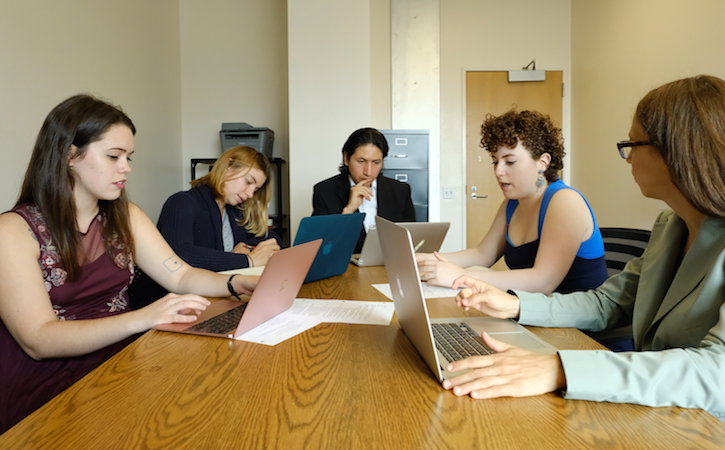
Language is an essential part of human experience. We use computational, experimental, and corpus linguistic methods to understand the unique role of language in our lives and in our society. The Experimental and Computational Linguistics Ensemble Lab (ECOLE) at San Francisco State University focuses on research on both cognitive and social aspects of language.
Research
Our research projects focus on both cognitive and social aspects of language. On one hand, we study linguistic phenomena that shed light on the question of grammar architecture and the relation between language and cognition. At the same time we are interested in what language reveals about its users and about society in general.
Generative AI and Large Language Models
Our most recent line of research focuses on Generative AI and Large Language Models. We study how Large Language Models perform compared to humans on a range of tasks, from world knowledge and common sense reasoning to text adaptation.
The Syntax and Semantics of Queries
The internet gave rise to a new form of language use – queries. Yet little is known about how we formulate queries. Queries are processed by search engines as ‘word salad’ with little attention to word order. In this project we investigate the hypothesis that queries are more than ‘word salad’ and that they have systematic structural properties.
Subjectivity in Language
Do you say Democrats and Republicans or Republicans and Democrats? In a series of papers we show that word order in binomials (above) and in prenominal adjectives depends on subjective preferences of the speaker: the attribute that is psychologically closer to the speaker is mentioned first.
Recent Publications
Smirnova, A., & Parker, R. 2026. Metaphors: Optional but preferred for conveying inferential meaning. In Proceedings of the 48th Annual Meeting of the Cognitive Science Society. pp. 4528-4534 https://escholarship.org/content/qt0v90p2db/qt0v90p2db.pdf
Iliev, R., & Smirnova, A. 2025. The valence of abstraction: A paradox revisited. Journal of Psycholinguistic Research 54, 4. https://doi.org/10.1007/s10936-024-10122-4
Smirnova, A., Chun, K., Rothman, W. L., & Sarma, S. 2025. Text Simplification for Children: Evaluating LLMs vis-à-vis Human Experts. CHI Conference on Human Factors in Computing Systems. https://doi.org/10.1145/3706599.3719889
Smirnova, A. 2024. Syntactic variation in reduced registers through the lens of the Parallel Architecture. Topics in Cognitive Science. Special volume on “Parallelism in the Architecture of Language,” Giosuè Baggio, Neil Cohn, and Eva Wittenberg (Topic Editors). https://doi.org/10.1111/tops.12747
Smirnova, A. 2024. Productivity and Creative Use of Compounds in Reduced Registers: Implications for Grammar Architecture. In Proceedings of the 46th Annual Conference of the Cognitive Science Society. https://escholarship.org/content/qt1c39n81t/qt1c39n81t.pdf
Reese, M. L., & Smirnova, A. 2024. Comparing ChatGPT and Humans on World Knowledge and Common-sense Reasoning Tasks: A case study of the Japanese Winograd Schema Challenge. CHI Conference on Human Factors in Computing Systems (pp. 1-9). https://doi.org/10.1145/3613905.3650975
Recent Presentations
Smirnova, A., & Parker, R. 2026. Metaphors: Optional but preferred for conveying inferential meaning. 48th Annual Meeting of the Cognitive Science Society. July 22-25, 2026. Rio de Janeiro, Brazil.
Khue Do, Holden Fees, Siya Patel, & Senula James Wijeratne. Expression of Proportion in K-5 texts written by Humans and LLMs. Stanford Research Conference. April 10-12, 2026. Palo Alto.
Smirnova, A., Lee, Erin S., & Li, S. 2025. Numeric information in elementary school texts generated by LLMs vs human experts. Artificial Intelligence in Measurement and Education Conference (AIME-Con). October 27-29, 2025. Pittsburgh, PA.
Reese, M. L., & Smirnova, A. 2025. Linguistic proficiency of humans and LLMs in Japanese: Effects of task demands and content. Artificial Intelligence in Measurement and Education Conference (AIME-Con). October 27-29, 2025. Pittsburgh, PA.
Reese, M. L., & Smirnova, A. 2025. Human and LLM performance on linguistic test: Content effect and task demands. 47th Annual Meeting of the Cognitive Science Society. July 30-August 2, 2025. San Francisco, CA.
Smirnova, A., Chun, K., Rothman, W. L., & Sarma, S. 2025. Text Simplification for children: Evaluating LLMs vis-à-vis human experts. CHI Conference on Human Factors in Computing Systems, April 26-May 1, 2025. Yokohama, Japan.
Kyu beom Chun, Diya Garg, Wil Louis Rothman, Siyona Sarma, & Shruti Sujal Vora. 2025. Text Simplification for Children. Stanford Undergraduate Research Conference. April 12, 2025. Stanford University, Palo Alto, CA.
Announcements
Raz Parker started PhD program in Linguistics at the University of New Mexico, and Wil Rothman started MA program in Computer Science at UC San Diego. Congratulations Raz and Wil!
Vindrew Sanderfer received the Marcus Undergraduate Research Fellowship for the project Iconicity through Foreign Language Recognition. Congratulations Vin!
Anastasia Smirnova presented Beyond Accuracy: Designing AI for Linguistic Accessibility. Invited lightning talk, AI & Minority Languages: A Bay Area Perspective. Irish Consulate, San Francisco, CA, April 29, 2026.
Raz Parker presented his paper on Automatic Identification of Phonetic and Semantic Patterns for Iconicity Research: A Transformer Approach at IcoLL2026. February 21-23, 2026, Nagoya University.
ECOLE Lab received Best Abstract award at 10th Annual UC Davis Symposium on Language Research for the project on Advantages and Challenges in using ChatGPT in Text Simplification for Children. May 24, 2024.
ECOLE Lab Members
Lab members come from diverse backgrounds and bring to the table their expertise in computer science, data analysis, linguistics and psychology.
Lab Director
Anastasia Smirnova
Professor Smirnova’s research focuses on the architecture of grammar and the structure of the lexicon, as well as on how temporal and modal information is expressed in language. Her more recent work examines language use and representation in Large Language Models, with particular attention to similarities and differences between human and LLM linguistic behavior. Her research employs a variety of methods, from fieldwork to experimental and corpus studies.
Lab Members
Angeles Daniela Alarcón
Daniela is an international student from Mexico, pursuing a master’s degree in Linguistics at SFSU and a Certificate in Computational Linguistics. Fascinated by how language shapes the way we understand the world, she is particularly interested in Cognitive Linguistics. At the ECOLE Lab, she hopes to connect these interests with NLP and LLMs while exploring new ways of studying language through computational methods.
Leila Chulani
Leila is an undergraduate student at the University of California, Berkeley, majoring in Data Science. Her interests include artificial intelligence and education, particularly how AI can support learning and make complex information more accessible. With experience teaching programming to students of different ages, she is excited to explore how humans and large language models approach text simplification and language.
Miguel Contreras
Miguel is an undergraduate student at the University of California, Berkeley, majoring in Computer Science, Data Science with a minor in Education. His academic interests focus on artificial intelligence and machine learning at the intersection of education, AI policy and Computer Vision. Outside of the lab, he enjoys running and reading.
Namira Khanum
Namira is an undergraduate student at the University of California, Berkeley, majoring in Electrical Engineering and Computer Science and minoring in Data Science. She is interested in the intersection of language and machine learning, especially computational linguistics and data-driven solutions. At ECOLE Lab, she hopes to learn new skills for these fields.
Isole Kim
Isole is an undergraduate student at the University of California, Berkeley, studying Cognitive Science and Linguistics. She is excited to return to ECOLE to continue exploring important questions in psycholinguistics, natural language processing, and accessible education.
Emily Markova
Emily is an undergraduate student at the University of California, Berkeley, majoring in Computer Science. She is interested in human-computer interaction and how thoughtful design can make technology more usable and accessible. As part of ECOLE Lab, she is excited to explore how educators and LLMs simplify text differently for students.
Wilson Medcalf
Wilson is an international student from Australia, currently studying a master’s degree in Linguistics at SFSU. He is interested in computational approaches to second-language acquisition and hopes to better understand how LLMs learn and represent language through his work at the ECOLE Lab. Outside of ECOLE, Wilson enjoys playing chess, running and hiking.
Cassia Reddig
Cassia recently received a Master of Science in Interdisciplinary Studies (emphasis in Language, Cognition, & Computation) with a Graduate Certificate in Ethical AI at San Francisco State University, where she also obtained a BA in Psychology and Computational Linguistics. She has contributed to research in the domains of cognitive psychology and media psychology through SFSU LACE Lab and Stanford Social Media Lab. She is interested in applying multidisciplinary approaches to the study of natural language processing and human-centered artificial intelligence.
Emily Robles
Emily is a graduate student earning her Master’s degree in Linguistics at San Francisco State University. She is curious about the intersection of language, technology, and society, especially how emerging technologies shape communication and influence the ways that social identities and experiences are expressed through language. She is delighted to further explore these interests by working with the ECOLE Lab.
Vindrew Sanderfer
Vindrew is an undergraduate student earning their Bachelor’s degree in Linguistics at San Francisco State University. They are currently working on research into cross-linguistic recognition of iconicity in language through the Marcus Undergraduate Research Fellowship, with Dr. Smirnova as their advisor. They are overjoyed to have the opportunity to do this research and work with the ECOLE Lab while doing it.
Lab Alumni
Helena Almassy. Professor of Mathematics, Cañada College.
Surya Appana (UC Berkeley Data Discovery Program).
Lauren Baker. Finance manager at DTR Consulting Services.
Kyu beom Chun (UC Berkeley Data Discovery Program).
Khue Nam Do (UC Berkeley Data Discovery Program).
Holden Fees (UC Berkeley Data Discovery Program).
Cole Fees (UC Berkeley Data Discovery Program).
Angie Garcia. Manager at Sound Hound.
Diya Garg (UC Berkeley Data Discovery Program).
Skyler Ilenstine. Computational Linguist at Microsoft via DISYS.
Malleeswari Jagabattuni (MJ). PhD student in Linguistics, University at Buffalo.
Jonathan Kakama. Data Analyst at Vaco.
Katie Kee (UC Berkeley Data Discovery Program).
Chohee Kim. Senior Software Engineer at LinkedIn.
Rose Kitchel. Executive Assistant at the Reeds Center.
Helena Laranetto. Machine Learning Data Linguist II, Alexa Devices at Amazon.
Erin Lee (UC Berkeley Data Discovery Program).
Shiying Li. Senior Software Engineer, Airbnb.
Tanvi Munjeti (UC Berkeley Data Discovery Program).
Sujung Nam. PhD student at the University of Hawaii, Honolulu.
Mikey Pagán. M.A. student, Comparative & World Literature at SFSU.
Ved Peesu (UC Berkeley Data Discovery Program).
Siya Patel (UC Berkeley Data Discovery Program).
May Reese. AI Safety researcher at Apart Research.
Thomas “Raz” Parker. PhD student in Linguistics, University of New Mexico.
Jasmine Rivero. Chatbot Operations Manager at Sense.
Amanda Robinson. Computational Linguist at Samsung.
Ricardo Romero Sanchez. Linguistic Project Manager at Google.
William “Wil” Louis Rothman (UC Berkeley Data Discovery Program). Graduate student at UC San Diego, Computer Science Department.
Siyona Sarma (UC Berkeley Data Discovery Program).
Laurel Selvig. Data Analyst at Axos Bank.
Erli Tang. PhD student in Linguistics and Anthropology at the University of Arizona.
Matthew Takagi (UC Berkeley Data Discovery Program).
Olivia Vallejo. LV Quality Specialist / Linguist.
Shruti Vora (UC Berkeley Data Discovery Program).
Senula Wijeratne (UC Berkeley Data Discovery Program).
Peixi “Max” Xie. AI Engineer.